
Laminated Veneer Lumber
Definition
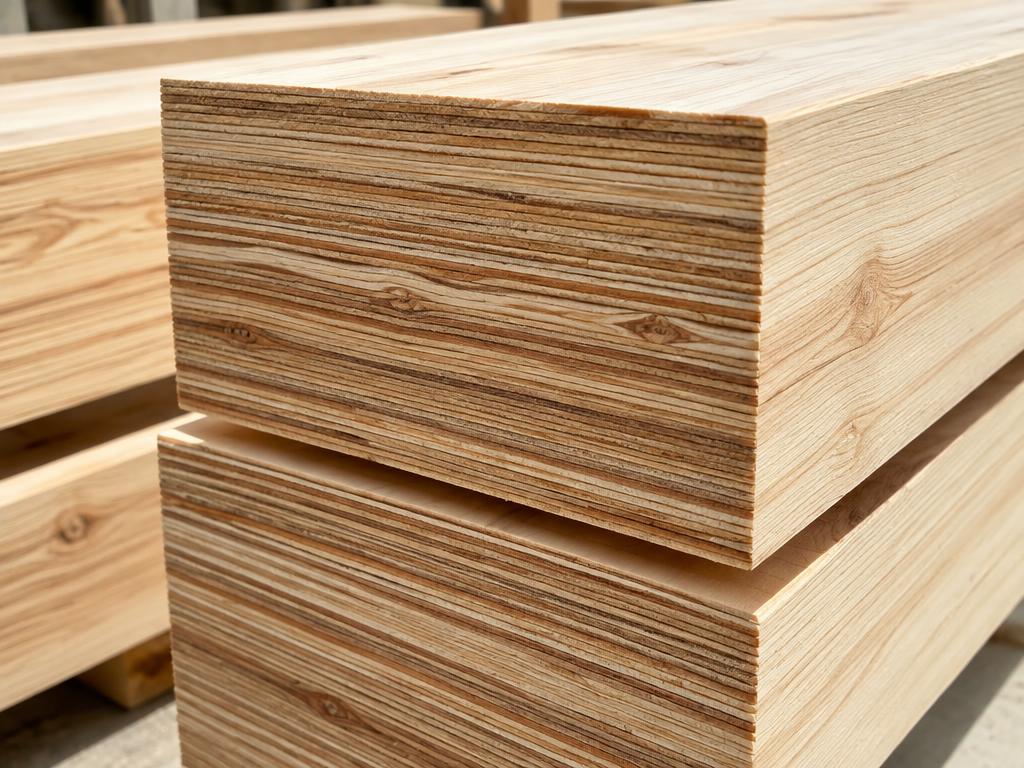
Laminated veneer lumber (LVL) is a high-strength engineered wood product manufactured by bonding multiple layers of thin wood veneers together with structural adhesives under heat and pressure. Unlike plywood, where grains are layered perpendicularly, LVL veneers are typically oriented in the same direction, resulting in a product that is stronger, straighter, and more uniform than solid-sawn timber. This manufacturing process disperses natural defects like knots throughout the material, providing high load-bearing capacity and dimensional stability that makes it less prone to warping, shrinking, or splitting. Widely used in both residential and commercial construction, LVL serves as a versatile structural component for headers, beams, rafters, and joists, often allowing for longer spans and heavier loads than conventional lumber.
Structural & construction notes
Common types of laminated veneer lumber include standard parallel-grained LVL for beams and headers and cross-banded LVL, which incorporates layers at right angles to improve shear strength and lateral stiffness. Products are also categorized by application, such as LVL S and LVL GS for primary columns and beams, or LVL X and LVL GX for members requiring higher stability against buckling. Laminated veneer lumber is primarily composed of thin wood veneers bonded with heat and pressure, often sourced from sustainable, fast-growing trees. It offers high durability due to its uniform strength and resistance to warping, making it more reliable than traditional lumber but susceptible to moisture damage unless treated for exterior use. While the initial material cost is higher than traditional lumber—ranging from 3 to 8 dollars per linear foot—it remains more cost-effective than steel or glulam and reduces long-term expenses through easier installation and superior load-bearing efficiency.
Frequently Asked Questions
An educational reference. Project-specific design requires professional guidance.