
Landing
Definition
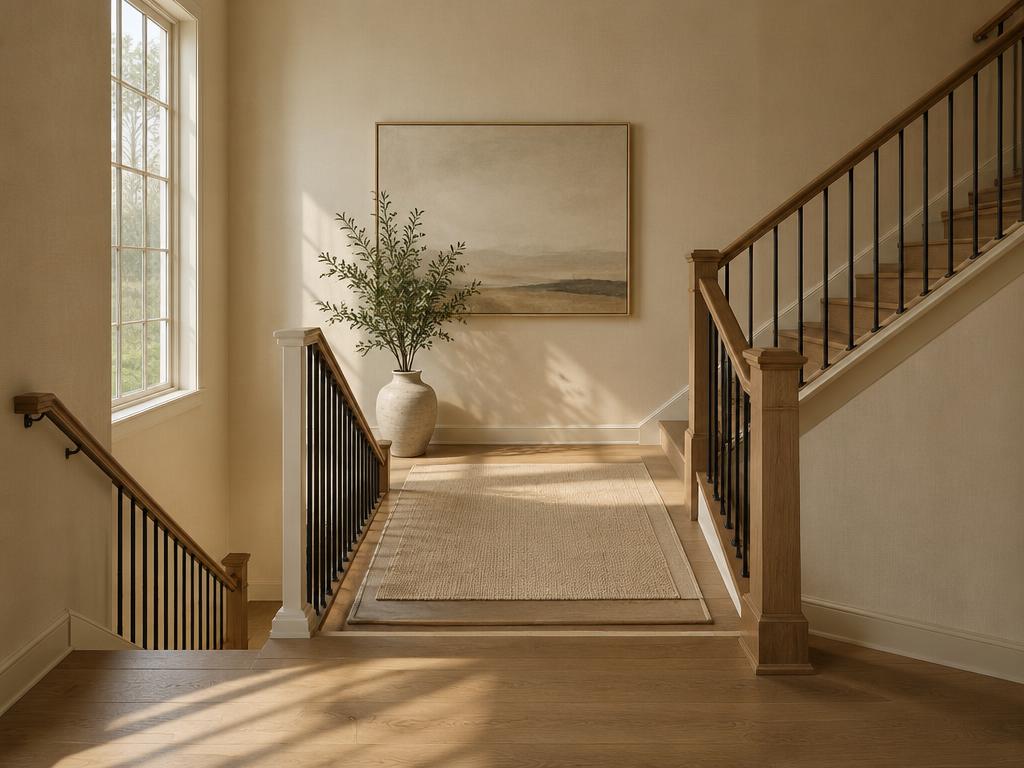
A landing is a flat, horizontal platform situated at the top or bottom of a staircase or between two flights of stairs to provide a resting place and facilitate a change in direction. It serves as a critical transitional space that enhances safety and accessibility by breaking up long runs of steps, thereby reducing the risk of falls and providing a pause point for users. Beyond its functional utility in managing vertical circulation and foot traffic flow, a landing can also function as an aesthetic feature, offering space for decorative elements, windows, or seating areas within a building's design.
Structural & construction notes
Common types of landings include straight landings that break up a single flight, L-shaped or quarter-turn landings that facilitate a 90-degree change in direction, and U-shaped or switchback landings that provide a 180-degree turn between parallel flights. Other variations include intermediate landings for rest or code compliance on long ascents, top and bottom landings at the start or end of a stairway, and curved or winder landings used in more complex architectural designs. Common materials for landings include wood (lumber and plywood), reinforced concrete, stone, and metal (steel or aluminum). High-durability materials like concrete and stone offer excellent longevity and stability for high-traffic areas but involve higher initial costs and complex installation. Affordable options like wood or vinyl-covered platforms reduce upfront investment but may require more frequent maintenance, while metal landing pans provide a durable, cost-effective structural base often used in commercial or industrial settings.
Frequently Asked Questions
An educational reference. Project-specific design requires professional guidance.